
Food and FMCG marketing for bulk buyers and shoppers
Product websites, branding, D2C campaigns and follow-up, and B2B enquiry funnels for food brands that sell to hotels, distributors, exporters and households.
Food and FMCG brands rarely sell through one channel. The same millet flour might go to a hotel kitchen in bulk, to an exporter, to a retailer under someone else's label and to a household through the brand's own website. Each of those buyers needs different information, and an FMCG digital marketing agency that only runs consumer ads will miss much of that revenue.
Trade buyers want specifications, pack sizes, licences, minimum order quantities and a fast way to ask for a quote. Shoppers want a reason to try the product, a clear price and an easy checkout. Distributors want to know the terms and how the brand will create demand in their area.
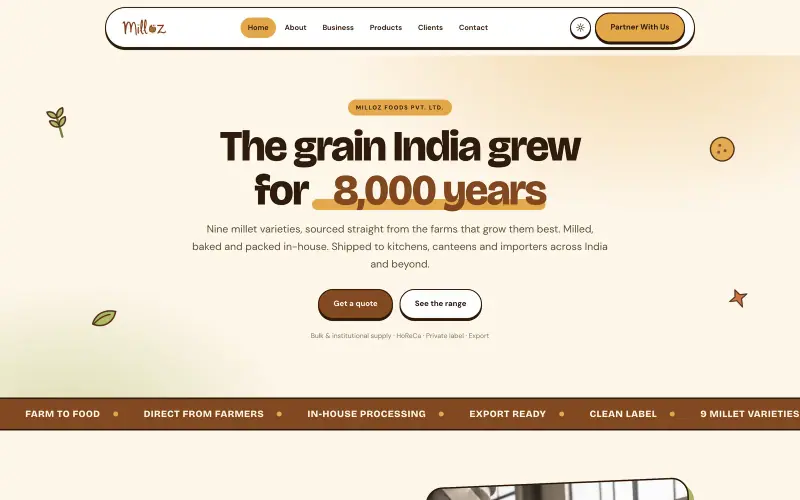
We built the website for Milloz Foods in three days. Milloz is an integrated millet business supplying grains, flours and cookies to hotels, restaurants, exporters and private-label buyers across India and Singapore. The site explains the product range, the business model and the supply options, captures bulk enquiries, and uses visual assets produced with generative AI tools. For consumer brands we add branding, e-commerce marketing and campaigns that sell through your own D2C store, with email and WhatsApp follow-up that brings customers back.
What we do for you
Product and brand websites
Product range, ingredients, nutrition and pack sizes, with a separate path for trade and bulk buyers.
B2B enquiry funnels
Pages for HoReCa, export, distribution and private label, each with a quote form that asks for volume, location and timeline.
Brand identity
Naming, logo and a visual system that carries across packs, website, social media and ads.
D2C stores that convert
Your own online store, with product titles, images, descriptions and delivery details that answer shoppers' questions before they buy.
Performance campaigns
Meta and Google campaigns for launches, trial offers and repeat purchase, plus search campaigns that reach trade buyers looking for suppliers.
SEO for product and supplier searches
Pages for how buyers search, from product categories to bulk supply and private-label manufacturing.
AI-assisted product visuals
Fast visual assets for launches, product pages and ads, used carefully so the product still looks like what arrives.
WhatsApp for trade and repeat orders
Catalogue sharing, enquiry routing and reorder reminders for distributors and customers who opted in.
- Brand or product website
- B2B enquiry pages and forms
- Product content and specifications
- Product page content for your store
- Meta and Google campaigns
- WhatsApp catalogue and follow-up
- Monthly sales and enquiries report
The process, step by step
A focused B2B product website can go live in days, as Milloz Foods did in three. Stores with large catalogues, integrations and campaigns take longer to set up and build results over the first few months.
Channel and buyer map
Week 1List who buys and through which channel, whether HoReCa, distributors, exporters, private label or your own D2C store.
Content foundations
Weeks 1 to 2Product information, specifications, photography or AI-assisted visuals, and the main message for each type of buyer.
Website or store build
3 days upwardsA focused site like Milloz Foods can be live in three days. A store with many products, payments and integrations takes longer.
Campaigns and follow-up
From launchConsumer campaigns, repeat purchase follow-up and trade enquiry campaigns, each measured on its own.
Measure by channel
MonthlyEnquiries by buyer type, cost per order, repeat purchase, and which products and channels are growing.
Work we have delivered
Watch the real walkthroughs or read how each project came together.
Who this works for
Good fit
- A food, beverage or FMCG brand with products ready to sell and clear pack sizes and pricing.
- You sell to trade buyers, consumers or both, and want each channel measured separately.
- You can send product for photography, sampling and content.
Not a fit
- ✕Your product does not yet have the FSSAI licence or registration and labelling it needs to be sold.
- ✕You expect a new brand with no reviews to sell out online within weeks.
- ✕You only want discount campaigns with no investment in the brand.
Food and FMCG work is scoped by channel. The website or store is a fixed project fee, and campaigns, follow-up flows and social media are a monthly retainer. Ad spend is separate.
What to expect from an FMCG digital marketing agency
Start by mapping revenue by channel, then measure each channel on its own terms. A single blended figure hides everything useful.
- Consumer sales: cost to acquire a customer, first-order value, and how many customers buy again within a set period.
- Your own store: conversion rate, average order value and revenue from email and WhatsApp follow-up.
- Trade and B2B: enquiries by buyer type, sample requests, quotes sent and orders won.
An agency that reports only reach, followers or a single return on ad spend figure is not measuring the business you run.
B2B food websites: what trade buyers look for
A hotel purchase manager or an exporter visits your site with a checklist. Make each item easy to find:
- Product specifications, including variety, pack sizes, shelf life and storage
- Licences and certifications, starting with your FSSAI details
- Minimum order quantities, supply capacity and typical lead times
- How private label works, from formulation to packaging and minimums
- Where you already supply, if your clients are happy to be named
- A quote form that asks for product, volume, delivery location and timeline
Milloz Foods needed exactly this: one site that explains grains, flours and cookies, the business model and supply options to very different buyers, and turns interest into bulk enquiries.
D2C stores and repeat orders
Your own store needs a fast e-commerce website with clear product pages, bundles and delivery details. Product pages need titles that match how shoppers search, images that show the pack, the product and a serving, and early reviews from genuine buyers, which sampling helps build. After the first order, reorder reminders for customers who opted in do much of the selling.
For launches, performance marketing usually works better when the offer is a low-risk trial, such as a small pack or a sampler, rather than a deep discount on the full range.
Mistakes that slow food brands down
- One homepage trying to speak to shoppers, distributors and exporters at once
- Discount-led campaigns that train customers to wait for the next sale
- AI-generated product images that do not match the real pack
- Health claims on ads and product pages that the label does not support
- Judging campaigns on return on ad spend without looking at repeat orders
Services that support this work
Website development
Launch microsites, corporate sites and booking sites designed and built in-house, SEO-first, with every enquiry sent to your Google Sheet and WhatsApp.
E-commerce and Shopify
Shopify stores and custom e-commerce websites for D2C and B2B brands, with product data, payments, shipping and conversion tracking set up properly before launch.
ExploreE-commerce marketing
Store conversion, Meta and Google campaigns, and email and WhatsApp follow-up that brings customers back, all reported against profit, not just revenue.
ExploreBranding
Positioning, logo and visual identity design, brand guidelines and launch collateral, built to look consistent on a hoarding, a brochure, a reel and a website.
ExplorePerformance marketing
Google, Meta and YouTube campaigns planned around cost per qualified lead and sales, with the landing page, tracking and lead follow-up run by the same team.
Questions people ask us
Should a food brand start with a D2C store or a B2B website?
It depends on who buys most. For B2B products such as bulk grains or private label, a B2B website comes first, because trade buyers search for suppliers, compare specifications and send enquiries directly. For consumer products, a D2C store builds margin, customer data and repeat orders, especially with email and WhatsApp follow-up. Many food brands need both, with a separate path for each type of buyer.
How do you generate B2B enquiries for a food business?
With pages built for each type of trade buyer, such as hotels and restaurants, exporters, distributors and private-label partners, each answering the questions that buyer asks. Search campaigns and SEO bring buyers looking for suppliers, and enquiry forms ask for volume, location and timeline so your team can prioritise. The Milloz Foods site was built around this model.
Is it safe to use AI-generated images for food products?
For mood, backgrounds, recipes and concept visuals, yes, and it saves time, as it did for Milloz Foods. For the product itself, the pack and anything a buyer relies on to decide, use real photography or check carefully that the image matches what arrives. Misleading food visuals damage trust and can break advertising rules.
What food advertising rules do we need to follow?
Claims on your packs, website and ads should match what your FSSAI licence and labels support. Avoid health claims you cannot back up, such as cures or guaranteed weight loss, and be careful with words like natural, fresh or pure, which FSSAI regulates. We flag risky claims while writing, and your regulatory adviser gives final sign-off.
Can you help us reach distributors and retailers?
We support distribution with the tools distributors ask for, including a trade page with the terms you choose to share, a product catalogue on WhatsApp, and local campaigns that create demand in a distributor's area. On-ground trade marketing, merchandising and sales visits stay with your team, and our role is to make those conversations easier.
Talk to us about food and FMCG
Tell us where you are today. We will come back with what we would do first, a timeline and a cost range, whether or not you hire us.
- A reply within one working day
- A clear scope before any commitment
- You own every account, file and asset we create
Thank you. We have your details.
Someone from the team will reply within one working day.