
Online stores that make buying easy
Shopify stores and custom builds for D2C and B2B brands, with fast product pages, payments, shipping and tracking set up before your first ad goes live.
Ecommerce website development is rarely held back by design. Stores lose sales in quieter places: a product page that takes several seconds to load on mobile data, a checkout that asks for too much, shipping charges that appear only at the final step, or a Meta pixel that stopped firing weeks ago and left the ads optimising blind.
We build on Shopify when a brand needs a dependable store its own team can run, and write custom code when the business model does not fit a standard cart. B2B buyers who need bulk quotes rather than a checkout are the most common example. Milloz Foods, a millet business supplying hotels, restaurants, exporters and private-label buyers across India and Singapore, needed exactly that: a D2C and B2B website presenting its product range and supply options, with bulk enquiry capture throughout. We built it on Next.js in three days, using generative AI tools for many of the visual assets.
If your store already exists and the problem is traffic, conversion or repeat orders, see e-commerce marketing instead.
What's included in e-commerce and shopify
Shopify store setup
Theme selection or customisation, collections, navigation, policies and store settings configured for how your customers buy.
Custom and B2B builds
Catalogues, bulk quote requests, wholesale enquiries and enquiry-led selling that a standard cart does not handle well.
Product pages that answer questions
Photos, variants, size or pack guides, delivery estimates and reviews placed where buyers look before adding to cart.
Payments and checkout
Payment gateway, payment options, discount logic and checkout fields trimmed to what is actually needed.
Shipping and order notifications
Shipping rates, courier integration, serviceable pin codes and order updates set up and tested with real orders.
Conversion tracking
GA4 e-commerce events, the Meta pixel with Conversions API and Google Ads conversions, checked so purchases are counted once.
Product data and feeds
Clean titles, attributes and images, with product feeds ready for Google Merchant Center and Meta catalogues.
Speed and search foundations
Compressed images, a lean set of apps, product schema and collection pages structured to rank.
- Store or website on your own account
- Product catalogue import
- Payment and shipping configuration
- GA4, Meta pixel and Conversions API setup
- Google Merchant Center product feed
- Store admin training session
The process, step by step
A focused D2C or B2B site can go live within days when products, photos and pricing are ready; Milloz Foods took three. Full Shopify stores with large catalogues, theme customisation and several integrations usually take a few weeks, confirmed after discovery. Fast-track delivery is available when a launch date is fixed.
Discovery
Days 1 to 2Products, SKUs, pricing, markets, payment and shipping needs, D2C or B2B, and the systems you already use.
Store architecture
Days 2 to 4Collections, filters, page templates and a shortlist of apps, keeping the store as light as the requirements allow.
Design and build
Days 3 to 20Home, collection, product, cart and content pages designed and built, with your brand applied throughout.
Catalogue, payments and tracking
Alongside the buildProducts imported, gateway and shipping connected, and tracking installed on a test version of the store.
Test orders and launch
2 to 3 daysReal test orders on every payment method, a refund, notification emails and conversion tracking verified before going live.
Work we have delivered
Watch the real walkthroughs or read how each project came together.

Motwani Lordsway Sanskruti
A cinematic launch microsite for a residential project on the sacred road to Puri, with Odia art direction and a Rath Yatra animated hero.

Vumee Amrapalli
A launch microsite for luxury 2 to 3.5 BHK apartments in Patia, Bhubaneswar, built around a scroll-controlled tower reveal.

Stalwart
A pre-launch teaser where scrolling plays a film from forest to clouds to the tower rising, built to create curiosity before the full reveal.
Stalwart Atmosphere
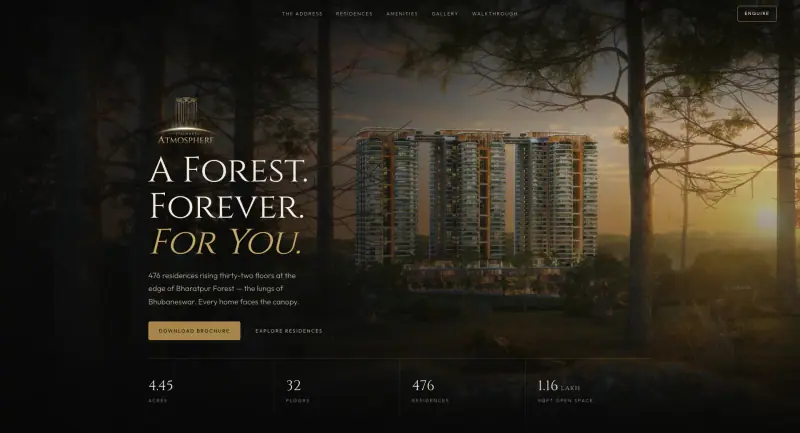
The full project site that followed the teaser: 476 three and four BHK residences facing Bharatpur Reserve Forest in Chandrasekharpur, Bhubaneswar.
Who this works for
Good fit
- You sell physical products, D2C, B2B or both, and want to own your store and your customer data.
- Product photos, prices and SKU data are ready, or you have budget to create them.
- You plan to run ads, SEO or WhatsApp campaigns to the store after launch.
Not a fit
- ✕You have a few products and no plan to drive traffic. A simple website with WhatsApp ordering may be enough.
- ✕You need a multi-vendor platform with seller dashboards. That is a software project, not a store build.
- ✕You expect the store to sell with no marketing budget behind it.
Cost depends on catalogue size, whether a theme is customised or built from scratch, the apps and integrations needed, and who prepares the product content. Shopify subscriptions, paid apps and payment gateway fees are billed to you directly. Hosting for custom builds and maintenance after launch are available as separate plans. You get a written scope and cost range before you commit.
Prepare these before ecommerce website development starts
Most e-commerce builds are delayed by missing inputs, not by design or code. Having these ready can save weeks:
- A product spreadsheet with SKU, title, price, MRP, variants, weight, dimensions, GST rate and HSN code for each item.
- Product photos on a consistent background, with at least one lifestyle or in-use image for key products.
- Policy pages: shipping, refunds and cancellations, privacy and terms. Payment gateways in India generally review these before approving your account.
- Payment gateway application, started early, because business verification can take several working days.
- A shipping plan: which courier or aggregator, which pin codes you serve, and which payment options you accept.
- Your domain, registered in the company's name.
Shopify or custom: a quick way to decide
Shopify suits brands with a standard catalogue, online payment and a team that wants to add products, run discounts and manage orders without a developer. Monthly subscription and app costs are the trade-off.
A custom build suits businesses where the buying process is a conversation, such as wholesale, private label, export or made-to-order products, or where the product range is one part of a larger brand story. It also suits brands that need full control over speed and design.
Some brands need both: a Shopify store for retail buyers and a separate enquiry-led section for trade customers.
What drives the cost of an online store
- Theme work. Configuring a good theme costs far less than designing custom templates.
- Catalogue size and data quality. Cleaning and importing 30 products is a different job from 3,000 with variants.
- Integrations. ERP, inventory, shipping, accounting, WhatsApp and CRM connections each add build and testing time.
- Content. Product photography, descriptions and AI-generated visuals are often underestimated.
Mistakes that cost sales after launch
- Too many apps. Each app can add scripts that slow every page. Remove anything that does not earn its place.
- Untested payment paths. Test every payment method, failed payments and refunds before launch, not after complaints.
- Hidden shipping costs. Show delivery charges and timelines on the product page, not only at checkout.
- Double-counted purchases. A pixel and Conversions API without deduplication will inflate reported sales and mislead your ad spend decisions. Deduplication is one of the first things our Meta Ads team looks at.
- No product schema. Structured data helps search engines show price and availability. Good SEO on collection pages brings buyers who never see your ads.
Often combined with
E-commerce marketing
Store conversion, Meta and Google campaigns, and email and WhatsApp follow-up that brings customers back, all reported against profit, not just revenue.
ExploreWebsite development
Launch microsites, corporate sites and booking sites designed and built in-house, SEO-first, with every enquiry sent to your Google Sheet and WhatsApp.
Meta Ads
Facebook and Instagram campaigns built on creative testing, the Conversions API and lead scoring with your sales team, the approach we used in Meta and Google property campaigns that produced 5,642 leads at ₹186 each.
ExploreSEO services
Technical, on-page, content and local SEO, plus visibility in Google AI Overviews and AI assistants, measured by enquiries rather than rankings alone.
Questions people ask us
Should we use Shopify or build a custom e-commerce website?
Choose Shopify if you sell a standard catalogue with online payment and want your own team to manage products, offers and orders without a developer. Choose a custom build if you sell mainly through bulk enquiries, need unusual pricing rules or want a content-led site where the catalogue is only one part.
How long does ecommerce website development take?
A product-range site with enquiry capture can go live within days if content is ready; Milloz Foods took three. A Shopify store with a customised theme, a few hundred products and integrations usually takes a few weeks. Preparing product data and payment gateway approval are often the slowest steps.
Are you a Shopify development company or do you only build custom sites?
Both. We set up and customise Shopify stores, and we build custom sites in frameworks such as Next.js when the business model needs it. The choice follows how you sell, how often your team updates the catalogue and which integrations you need.
Can our website take B2B or bulk orders instead of online payment?
Yes. For B2B buyers, a well-structured enquiry form often beats a checkout, because order sizes, pricing and delivery terms need a conversation. Milloz Foods uses bulk enquiry capture for hotels, exporters and private-label buyers. Enquiries can go straight to a Google Sheet, WhatsApp or your CRM.
Will the store be ready for Google Shopping and Meta ads?
Yes, if that is in scope. We set up product feeds for Google Merchant Center and Meta catalogues, install the Meta pixel with Conversions API, configure Google Ads and GA4 purchase events, and place a test order to confirm each one records the sale correctly and only once.
Who owns the store and customer data?
You do. The Shopify account, the domain, the payment gateway, product data and the customer list are all set up in your name. We can host custom builds and maintain the store on a maintenance plan, working through access you can remove at any time, so switching agencies later never means rebuilding the store or losing order history.
Talk to us about e-commerce and shopify
Tell us where you are today. We will come back with what we would do first, a timeline and a cost range, whether or not you hire us.
- A reply within one working day
- A clear scope before any commitment
- You own every account, file and asset we create
Thank you. We have your details.
Someone from the team will reply within one working day.